Five Updates, One QR Code, Almost No Ziyarat — Infinite Mercy Anyway
A Madinah story about a stubborn app, a patient world, and how the sacred still wins

Let me put it plainly.
My ziyarat of the Prophet ﷺ nearly didn’t happen.
Not because of crowds.
Not because of timing.
But because the Nusuk app almost refused to cooperate.
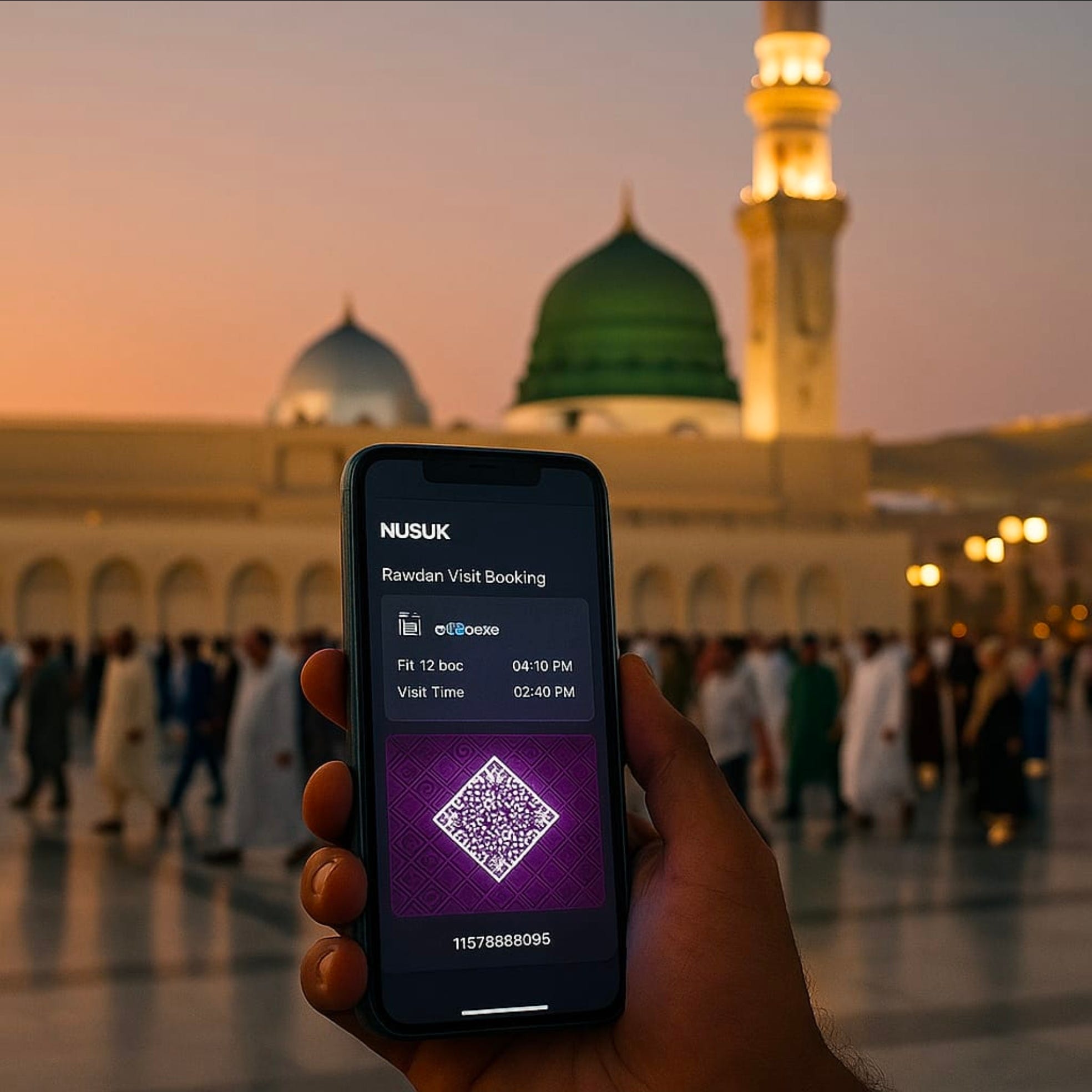
This was not inconvenience.
This was a test of iman via software.
The App That Nearly Blocked Destiny
Madinah.
Heart ready.
Salawat loaded.
Phone says: “Updating…”
Then it spins.
Freezes.
Crashes.
I reopen it.
It closes itself—politely but firmly.
I refresh.
It punishes me.
Around me, humanity moves forward in calm submission while my phone debates the meaning of existence.
A Pakistani uncle looks over with the empathy of a man who has suffered similarly.
An Indonesian woman offers advice with corporate confidence:
“Restart phone. Always works.”
It does not.
When Ziyarat Depends on Battery Life
This is the moment no book prepares you for.
You are meters from the inner sanctum of Prophet's ﷺ mosque.
yet spiritually grounded by a loading icon.
I whisper du‘a.
Then, inevitably, negotiate with my operating system.
Ya Allah, I promise fewer apps. Just this one.
For a brief, unsettling moment, I accept defeat.
I will go home and say,
“I went to Madinah… but my app didn’t open.”
A modern tragedy.
No martyrdom.
Just poor connectivity.
Meanwhile, the World Waits Politely
I look up from my failing screen.
And there it is.
The Ummah—standing patiently in line.
A Pakistani uncle counting tasbih with surgical focus.
A Nigerian brother smiling like delays are sunnah.
A Turkish grandfather whispering salawat, immune to time.
An Indonesian family managing three generations with calm authority.
A Sudanese pilgrim offering tech advice he may or may not understand.
A British convert quietly Googling, “What is a Ziarah?”
Skin tones change every few steps.
Accents collide and apologize.
Everyone shares the same expression when the line moves: cautious hope.
This isn’t a queue.
It’s global cooperation with excellent manners.
Wheelchairs: The Only VIP Lane That Matters
Then the wheelchairs pass.
No sighs.
No resistance.
No entitlement.
A Pakistani grandmother pushed by her grandson—clearly promoted to operations manager.
A Turkish auntie guided by a Nigerian brother she met moments ago.
An Arab volunteer orchestrating movement with calm authority.
No shared language.
Perfect understanding.
In Madinah, fragility goes first.
Strength steps aside automatically.
No announcements required.
The Fifth Update (Mercy, Disguised)
Then—on the fifth attempt—
It happens.
Not thunder.
Not angels.
A QR code.
Small.
Purple
Unreasonably powerful.
I stare at it the way our elders once stared at the sky to confirm Ramadan.
Is this real?
Should I screenshot it?
Frame it?
Laminate it?
Five updates.
One rectangle.
Infinite relief.
The Vast Sahan
Now I cross the humongous sahan—wide, luminous, forgiving.
White marble reflecting every shade God ever imagined.
Thobes.
Abayas.
Shalvars
Shawls.
Even jeans
Walking speeds ranging from urgent to philosophical.
Some pilgrims move with purpose.
Others wander happily lost.
A few consult Google Maps—still wrong, still blessed.
Then the glittering tiles.
Smooth.
Shiny.
A mercy from the future for feet from every past.
A Filipino nurse glides beside a Canadian retiree.
An Afghan father balances a child while silently thanking the inventor.
The walkways:do not judge.
It carries everyone equally.
Thirty Minutes of Eternity (4:10–4:40)
Then the app—after all its resistance—offers a window:
4:10 to 4:40.
Thirty minutes.
Typed in digits.
Measured by a clock that suddenly feels very small.
I don’t ask for more.
I don’t bargain.
I just whisper it—softly, instinctively:
Thank you, Allah.
Because those thirty minutes are not a restriction.
They are a concentration of mercy.
Enough time to send salam.
Enough time to stand still.
Enough time to feel small, safe, and seen.
The window doesn’t limit the experience.
It seals it.
I place it quietly on a private shelf in the heart—
where moments are not overexplained,
not repeated too often,
not handed around casually.
Some experiences are meant to be shared.
Others are meant to be added to the precious.
Handled gently.
Remembered quietly.
Carried for life.
The Moment That Needs No Technology
Finally- I show the QR Code.
A nod from the volunteer.
A gentle gesture forward.
No flags.
No accents.
No explanations.
Just a salam.
And in that instant, everything disappears.
The app.
The updates.
The panic.
It’s just you—
and the man ﷺ who welcomed everyone
long before QR codes decided who goes next.
Here’s the quiet joke Madinah delivers flawlessly.
We arrive with apps.
With systems.
With five failed updates.
And Madinah says,
“Fine. Bring them.”
Then it lines us up—
Pakistanis and Indonesians,
Africans and Turks,
Arabs, converts, elders, children—
and gives us the most undigital moment imaginable.
You can manage crowds.
You can regulate movement.
But love?
Love doesn’t buffer.
It doesn’t crash.
And it never fails to load.
The Nusuk app almost didn’t work.
Almost.
But mercy did.
As I turned away, not in haste but in gratitude, the moment refused to leave me.
It followed—not as memory, but as meaning.
A line surfaced, as if it had been waiting all along:
Ki Muhammad ﷺ se wafā tū ne to hum tere hain
Ye jahān chīz hai kyā, lauḥ-o-qalam tere hain
If you remain faithful to Muhammad ﷺ, then We are yours.
This world—what is it, after all? Even the Pen and the Tablet belong to you.
And in that light, everything softened.
The app.
The QR code.
The narrow window of time.
All of it fell into place.
Some encounters are timed by clocks.
Others are written beyond time.
And those—
those never close.
And that, perhaps, was the lesson all along.